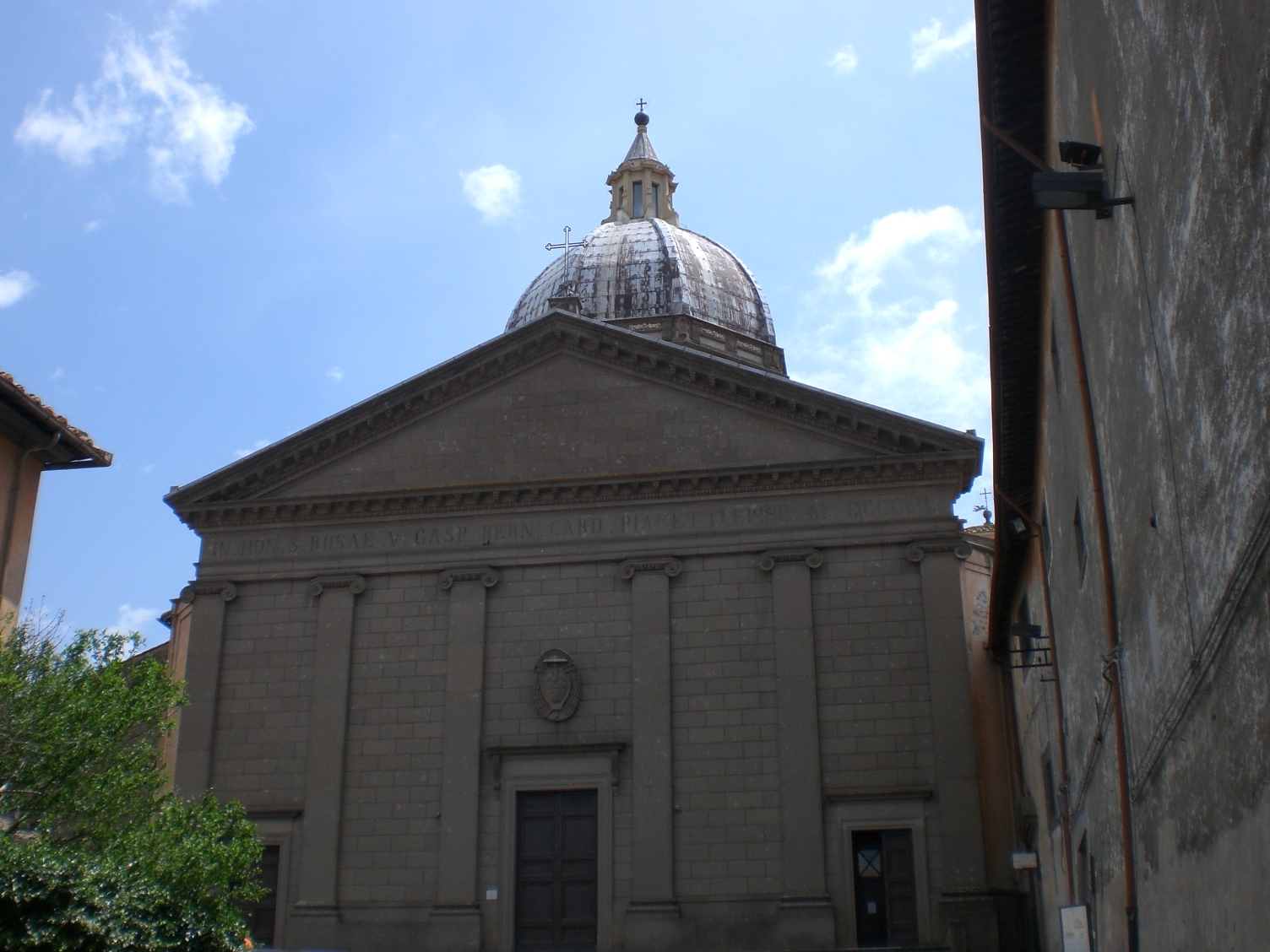

The church of S. Rosa was rebuilt in 1850 on the site of a pre-existing temple belonging to the Poor Clare nuns, on the initiative of the then bishop of the city. On the place of the present building there was a small church and a monastery, initially named after St. Mary, ruled by the Poor Sisters of St. Damianite of Assisi (name of the first female monastic order, also known as the Damianite, called the Poor Clares after the canonization of St. Clare in the cathedral of Anagni). In the ancient complex, of which there is news since 1235, in 1258 Pope Alexander IV (1254-1261) moved the body of S. Rosa (which already lay near the nearby church of S. Maria in Poggio, otherwise known as the church of the Crocetta), and towards the middle of the following century the new dedication to the saint became the patron saint of Viterbo. The primitive temple, destroyed for the first time in 1350, was admirably frescoed by Benozzo Gozzoli in the middle of the fifteenth century, with the representation of episodes from the life of S. Rosa. After the radical rebuilding and enlargement of the church, undertaken around the middle of the seventeenth century, the masterpieces were lost: nine watercolour copies are currently kept in the city's Civic Museum; two preparatory drawings made by Gozzoli himself for the church of the Poor Clares, although never transferred in fresco, are instead at the Britisch Museum in London and at the Prints Cabinet in Dresden. The reconstruction of the building in the mid-nineteenth century was inspired by the forms of the sixteenth-century church of S. Maria delle Fortezze (now almost destroyed), according to a combination of late-Renaissance and Neoclassical styles which, however, failed to revive the ancient spirituality of the place. To the structure, entirely made of peperino, in 1913 the architect A. Foschini added the new dome, larger than the previous one, with a suggestive majolica covering (later hidden by lead slabs).
According to legend, St. Rose passionately begged to be admitted to the Order of the Poor Clares, without ever succeeding because she was considered a rebel. A few years after her death, Pope Alexander IV, after having had her several times in a dream, tried to glorify her memory by moving her body near the place so dear to her. This episode is alluded to by the celebration of the "transport" of the so-called "S. Rosa's car", which takes place every year in Viterbo: a huge papier-mâché building in the form of a bell tower is transported through the streets of the city, from the church of S. Sisto to the sanctuary of S. Rosa, to which, according to tradition, the "porters" run up the stairs. The Viterbo church is otherwise known to have next to it the house where S. Rosa was born in 1233 and where he died in 1252, annexed to the sanctuary in 1661 at the behest of the nuns.