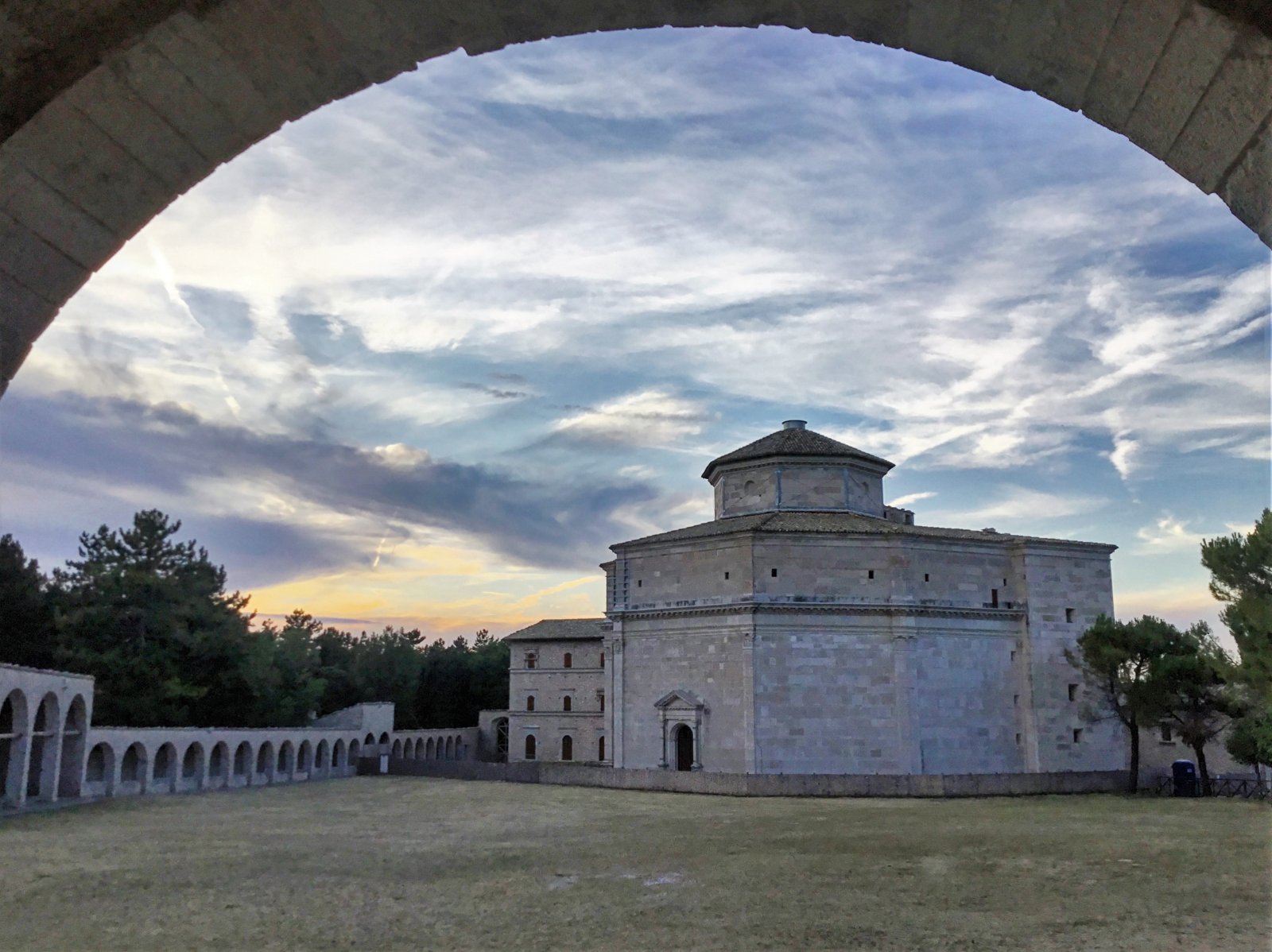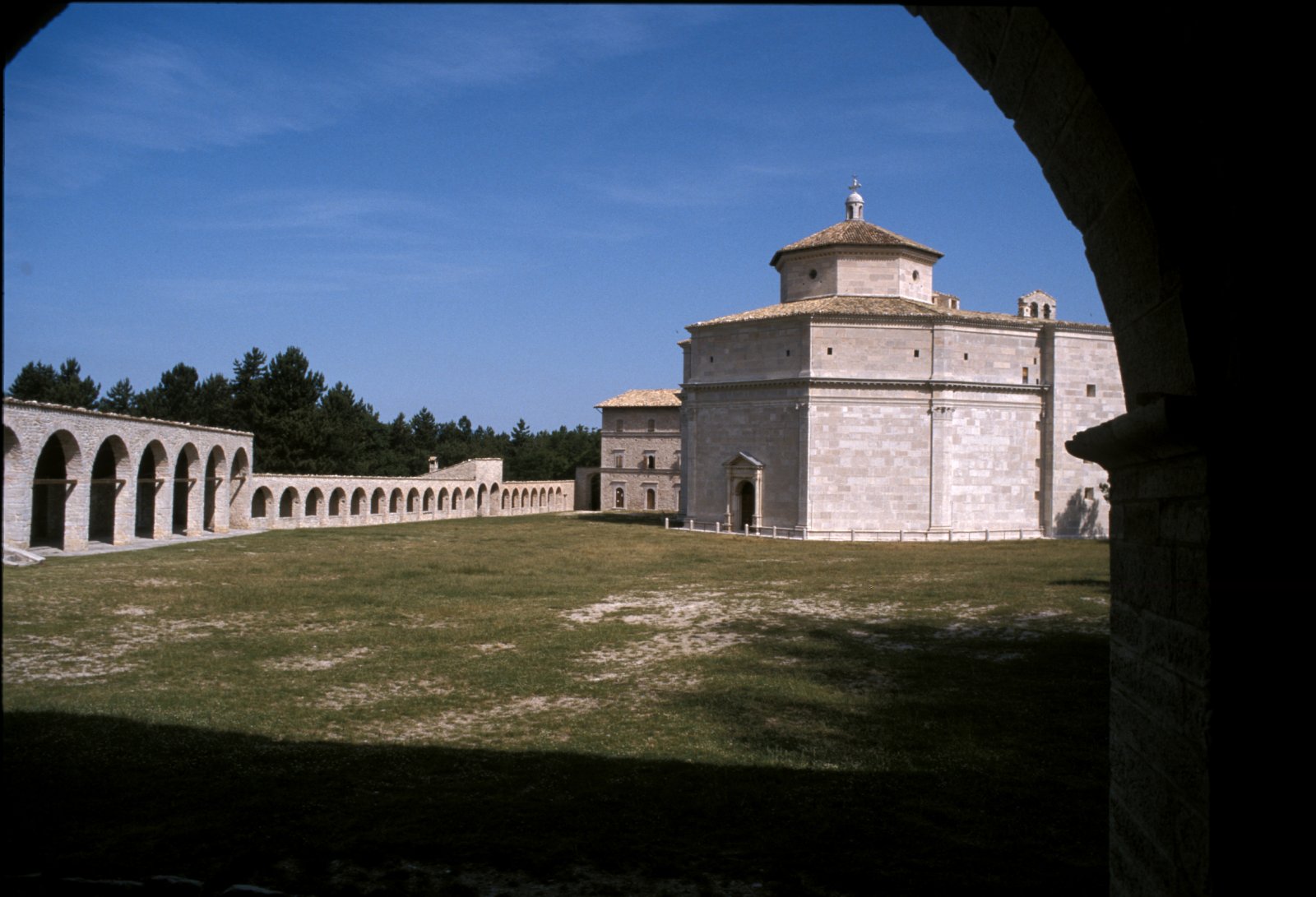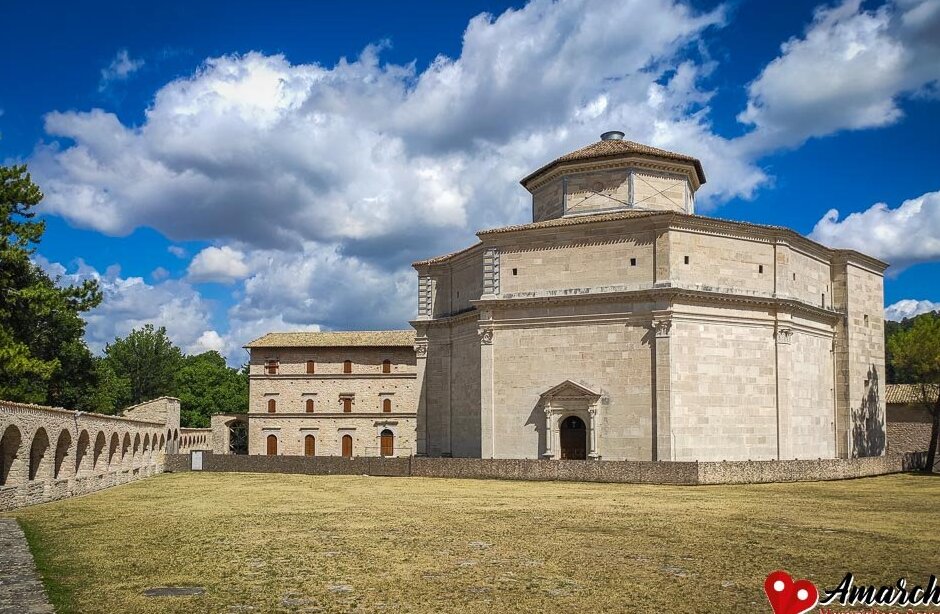

The Sanctuary of Macereto is a religious complex that stands on a plateau on the western side of the Sibillini Mountains a few kilometers from Visso, about 1,000 meters above sea level on the site where, according to tradition, on August 12, 1359 a mule carrying from Ancona to the Kingdom of Naples a statue of the Madonna knelt here and did not want to leave. Some passers-by, rushing to lend their help, saw in what had happened a divine sign and demanded that a small church be built here to house the image of the Madonna. Then arose the primitive chapel on an ancient route lauretano that pilgrims of Abruzzo and Sabina traveled to reach the Sanctuary of Loreto. In 1529 the community of Visso commissioned some Lombard masters who worked in Umbria to build a larger church that could contain the old chapel and then began work on the design of the architect Giovan Battista da Lugano, who took a project of Bramante in 1505. With the death of Lugano, who fell from the scaffolding and was buried here, the work was interrupted and resumed only in 1553 under the guidance of Filippo Salvi da Bissone, to finish in 1556. The Sanctuary, entirely covered in travertine, has an octagonal plan with three avant-corps on which there are three portals facing Visso, Ussita and Cupi, richly sculpted and embellished with bas-reliefs and columns with Corinthian capitals that give access to the interior. The main façade has a round window with a notched frame and a splayed portal with bas-reliefs while the back of the structure is composed of an irregular body in which, at the end of the works, was incorporated what remains of a high bell tower that, due to a subsidence of the ground, was no longer raised. The interior is in the shape of a Greek cross with the four arms ending in four apses with niches. The arches that support the dome rest on Doric and Corinthian pillars that are leaning against a second order of walls. At the centre of the church it is possible to admire the primitive chapel that, between 1585 and 1590, Pietro Casella di Corona covered with local stone. The chapel has two portals with classical elements and inside there is a gilded wooden altar of the sixteenth century and a copy of the statue of the Madonna of 1400 whose original is now preserved in the Museum Art Gallery of Visso (set up inside the Church of St. Augustine). In the apse that contains the high altar there are valuable stuccoes, statues and some works of Simone de Magistris, realized between 1580 and 1582 among which we can mention: the Christmas of Jesus, the Adoration of the Magi, the Descent of the Holy Spirit, the Circumcision, the Nativity of the Madonna and the Flight into Egypt. On the high altar made of travertine marble in 1924 and placed in the middle of the apse, is depicted the Resurrection that the painter Angelo Righi made in 1598. On the architrave of the door leading to the choir stalls, a bas-relief representing Saint Catherine of Alexandria and two candlesticks was carved in 1560. Between 1534 and 1549 Paul III, who at that time as a cardinal visited the town of Visso and Macereto, elevated the church to a Basilica. In 1741, thanks to a handout from Clement XII, the church was restored and, in memory of this, at the end of the work, two plaques were placed on the exit wall of the church. The one on the right commemorates the protection of the Virgin Mary during the earthquakes of 1719 and 1730 and the above mentioned works; the one on the left commemorates the protection of the Virgin Mary during the plague of 1657 and the earthquake of January 14th 1703. On September 26, 1997 a violent and continuous seismic swarm raged for days over the whole territory and the Sanctuary suffered serious damage including the detachment of the three external portals from the masonry behind, numerous injuries, serious fractures and openings of cracks a little 'on the whole structure. The Conference of Services on August 6, 1999 approved a project for the renovation of the affected areas that, thanks to the restoration work, could return to their former glory.